Meeting Notes
10th Meeting – Monday 14 July 2025
| Attendees |
|---|
| Professor Henrietta Hughes (Chair – Patient Safety Commissioner) |
| Louise Ansari (Healthwatch England) |
| Rabbi Dr Harvey Belovski |
| Helen Buckingham (National Voices) |
| Saffron Cordery (NHS Providers) |
| Dr Mike Durkin (Imperial College London) |
| Ian Green (Chair, Shropshire, Telford and Wrekin ICB) |
| Rachel Power (Patients Association) |
| Apologies |
| Dr Habib Naqvi (NHS Race and Health Observatory) |
| PSC staff members in attendance |
| Rachel Downey |
| Mel Peffer |
| Tom Savage |
Meeting Notes
| 1. | Welcome & apologies |
|---|---|
| 1.1 | The Chair welcomed everyone to the meeting. Apologies had been received from Habib Naqvi. Ian Green said he was now the Chair and Non-Executive Director of Shropshire, Telford and Wrekin ICB. |
| 1.2 | The Chair expressed her sincere thanks to Saffron Cordery who would be leaving NHS Providers in early August and this would be her last Advisory Group meeting. |
| 2. | Note of the previous meeting (1 May 2025)
|
| 2.1 | There were no corrections to the notes of the last meeting (1 May 2025), which were agreed and would be added to the PSC website. All actions were complete or in hand (Saffron would follow-up if required on the comms action). |
| 3. | Dash Review and the 10 Year Health Plan |
| 3.1 | The discussion started by the Chair and Members reflecting how the changes in the Dash Review and trailed in the 10 Year Health Plan were communicated to staff in the affected organisation, how they found out about changes and the unanswered questions that remain. First and foremost there was a need for staff to be supported, particularly in those organisations most impacted by the Dash recommendations. |
| 3.2 | There was a general discussion which covered elements of both the 10 Year Health Plan and Dash Review including, for example: the perceived power imbalance in the system; the importance of an independent patient voice; and the implications of the new proposed Directorate of Patient Experience located with DHSC and how long this might take to be fully established. It was noted that across all Dash recommendations there would a huge amount of work to do, to unpack what was required and transition towards implementation of the recommendations. |
| 3.3 | The Chair explained that the specific recommendation relating to the PSC hosting arrangements transferring to MHRA did not require any changes to legislation (unlike many of the other recommendations). The Chair viewed the new hosting arrangement as creating an opportunity to ensure the continued focus on patient voice in the work of the MHRA and help it achieve its patient safety mission. The Chair said her first three-year term as Patient Safety Commissioner was due to end in September and she was awaiting a decision on appointment for a second term as provided for in the legislation. |
| 4. | Chair’s Update |
| 4.1 | Much of the discussion at this shorter meeting of the Advisory Group focused on the implications of the recently published Dash report and its recommendations. Other updates from the Chair included:
|
| 5. | Forward look including transition planning post-Dash |
| 5.1 | Items included:
|
| 6. | AOB |
| 6.1 | None |
| 7. | Next Meeting |
| 7.1 | The next meeting was already in diaries for Thursday 23 October. The Chair thanked everyone for their support. |
9th Meeting – Thursday 1 May 2025
| Attendees |
|---|
| Professor Henrietta Hughes (Chair – Patient Safety Commissioner) |
| Louise Ansari (Healthwatch England) – joined remotely |
| Helen Buckingham (National Voices) – joined remotely |
| Saffron Cordery (NHS Providers) – joined remotely |
| Dr Habib Naqvi (NHS Race and Health Observatory) – joined later, remotely |
| Apologies |
| Rabbi Dr Harvey Belovski |
| Dr Mike Durkin (Imperial College London) |
| Rachel Power (Patients Association) |
| Ian Green (Chair of Salisbury NHS Foundation Trust) |
| PSC staff members in attendance |
| Rachel Downey |
| Mel Peffer |
| Tom Savage |
| PSC staff members in attendance |
| Rachel Thomsen (PhD Student) |
Meeting Notes
| 1. | Welcome & apologies |
|---|---|
| 1.1 | The Chair welcomed everyone to the meeting. Apologies had been received from Harvey Belovski, Mike Durkin, Rachel Power and Ian Green. |
| 2. | Note of the previous meeting (30 January 2025)
|
| 2.1 | There were no corrections to the notes of the last meeting (30 January 2025), which were agreed and would be added to the PSC website. There were no actions or other matters arising. |
| 3. | Chair’s Update |
| 3.1 | In a change to the previous agenda order circulated the Chair suggested she cover her general update first in case other members joined slightly later for the main discussion. |
| 3.2 | Today was the Team’s last day in 18 Smith Square due to the lease coming to an end and it not being possible to renew on a short-term basis pending the outcome of the Dash Review. Instead the team would have use of desk/meeting room facilities at 39 Victoria Street. |
| 3.3 | The Chair provided an update on activities since the last meeting adding that the current uncertainties had not stopped the team from pushing forward with work.
Patient Safety Principles
|
| 4. | Dash Review of patient safety across the health and care landscape (depending on publication date) |
| 4.1 | There was no date yet for the publication of the Dash Review, and this was discussed within the broader context of the recently announced NHSE/DHSC merger and ALB review, and the forthcoming 10 Year Health Plan. |
| 4.2 | The team was preparing a draft business plan and in doing so were taking a pragmatic, practical approach; and as a starting point reviewing the existing work, including recommendations and strategy and being realistic about the capacity for new work within current staff resources (three civil servants) and pending the Dash Review. |
| 5. | Forward Look |
| 5.1 | Items included:
|
| 6. | AOB |
| 6.1 | Habib Naqvi reported that the NHS Race and Health Observatory (NHSRHO) would shortly be entering a partnership agreement with NICE to tackle persistent and systemic ethnic health inequalities. Habib also referred to NHSRHO’s Anti-Racism Principles having been adopted by CQC as both an employer and regulator and there were plans with the GMC to bring together all regulators at a roundtable. |
| 7. | Next Meeting |
| 7.1 | The next meeting was in diaries for 24 July but would be revisited to ensure maximum attendance at the next meeting. Action: Secretariat to contact members for revised availability The Chair thanked everyone for their support, and the meeting finished early. |
8th Meeting – Thursday 30 January 2025
| Attendees |
|---|
| Professor Henrietta Hughes (Chair – Patient Safety Commissioner) |
| Rabbi Dr Harvey Belovski – joined remotely |
| Dr Mike Durkin (Imperial College London) – joined remotely |
| Dr Habib Naqvi (NHS Race and Health Observatory) – joined remotely |
| Rachel Power (Patients Association) – joined remotely |
| Apologies |
| Louise Ansari (Healthwatch England) |
| Saffron Cordery (NHS Providers) |
| Helen Buckingham (National Voices) |
| Ian Green (Chair of Salisbury NHS Foundation Trust) |
| PSC staff members in attendance |
| Mel Peffer |
| Tim Power – joined remotely |
| Tom Savage |
Meeting Notes
| 1. | Welcome & apologies |
|---|---|
| 1.1 | The Chair welcomed everyone to the meeting. Introductions were made for the benefit of Tim Power from DHSC who would be providing interim assistance to the PSC in the interim, due to two members of the Team having moved at short notice back into DHSC to work on the assisted dying bill. |
| 2. | Note of the previous meeting (7 November)
|
| 2.1 | There were no corrections to the notes of the last meeting (7 November 2024), which were agreed and would be added to the PSC website. Under action 2 – at the time of the last meeting it was thought that the Dash review would be published by now; this has not yet happened. There were no matters arising. |
| 3. | Dash Review of patient safety across the health and care landscape |
| 3.1 | The Chair gave an overview of some of the history leading up to the Dash review, including PHSO’s 2023 report, Broken Trust. Following on from Dr Penny Dash’s review into the operational effectiveness of the CQC, last Autumn she was then asked to undertake an independent review of patient safety across the health and care landscape. |
| 3.2 | This latest review was looking at 6 organisations: Care Quality Commission (CQC) – including the Maternity and Newborn Safety Investigations programme; National Guardian’s Office (NGO) – hosted by CQC; Healthwatch England (HWE) and the Local Healthwatch (LHW) network – HWE is also hosted by CQC; Health Services Safety Investigation Body; Patient Safety Commissioner; and NHS Resolution (patient safety-related learning functions only, not clinical negligence functions). |
| 3.3 | Whilst MHRA and NHS England were not included in this latest review it was understood that the review team had spoken with both these organisations as part of the process. Members reflected on the process to date and it was noted that whatever the outcome there would be need to be a credible narrative making clear how any proposed changes would improve patient safety. It was hoped the Report from this latest review would be published soon. |
| 4. | Update on Patient Safety Principles implementation |
| 4.1 | Tom Savage gave a brief update on work to implement the Patient Safety Principles, and the engagement to date with individuals and organisations to raise awareness, and to help ensure the principles are as integrated as possible into the health and care system. |
| 4.2 | This has included engaging with and presenting to regulators, providers, policy makers and professional bodies with examples including NHS Providers, CQC, Professional Standards Authority, Association of British HealthTech Industries (ABHI), Independent Healthcare Providers Network (IHPN), and different parts of the Department of Health and Social Care with policy responsibility for areas such as the MedTech Strategy, the 10-Year Health Plan and the NHS Constitution. |
| 5. | Update on Accessible Medicines Project |
| 5.1 | The Chair reminded members this work was examining the barriers to patient safety in relation to the medicines and medical devices for patients with sensory impairment (hearing and/or sight loss/impairment), with a focus in particular on the experience of patients with visual impairment who have diabetes. The project was progressing well and the academic partner leading this work had prepared her draft report which was being reviewed for factual accuracy by those involved in the project. An update would be shared at the next meeting. |
| 6. | Chair’s update |
| 6.1 | The Chair provided the following updates:
|
| 7. | Forward look |
| 7.1 | In addition to the ongoing work already covered, forthcoming events included a meeting with Sharon Hodgson MP the new Chair of the First Do No Harm APPG and various presentations on the Patient Safety Principles and Martha’s Rule. |
| 8. | AOB |
| 8.1 | None. The meeting finished early. |
| 9. | Next meeting |
| 9.1 | Thursday 1 May |
7th Meeting – Thursday 7 November 2024
| Attendees |
|---|
| Dr Henrietta Hughes (Chair – Patient Safety Commissioner) |
| Saffron Cordery (NHS Providers) |
| Baroness Julia Cumberlege |
| Dr Mike Durkin (Imperial College London) |
| Dr Habib Naqvi (NHS Race and Health Observatory) |
| Rachel Power (Patients Association) |
| Apologies |
| Louise Ansari (Healthwatch England) |
| Rabbi Dr Harvey Belovski |
| Helen Buckingham (National Voices) |
| Ian Green (Chair of Salisbury NHS Foundation Trust) |
| PSC staff members in attendance |
| Andrew Biden |
| Rachel Downey – joined remotely |
| Moore Flannery |
| Mel Peffer |
| Tom Savage – joined remotely |
Meeting Notes
| 1. | Welcome & apologies |
|---|---|
| 1.1 | The Chair welcomed everyone to the meeting and thanked members for their help, support and scrutiny. Apologies had been received from Louise Ansari, Harvey Belovski, Helen Buckingham and Ian Green. A short information paper had been circulated to supplement the agenda. |
| 2. | Note of the previous meeting (18 July)
|
| 2.1 | There were no corrections to the notes of the last meeting (18 July 2024), which were agreed and would be added to the PSC website. |
| 2.2 | The actions from the last meeting were reviewed, some of which would also be covered during other agenda items. The Chair reminded members to notify any changes to their register of interest listing on the website. |
| 2.3 | Under action 3, the Chair had met with Baroness Finlay who had raised the assisted dying bill. Under action 4, the Chair thanked members for responding to the Principles consultation; under action 5 the Chair confirmed she had taken part in a Patients Association webinar during Patient Safety Week on 2 September. There were no matters arising. |
| 3. | Patient Safety Principles |
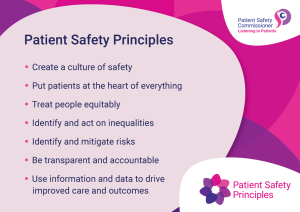
| 3.1 | The Chair gave an overview of the Patient Safety Principles which had been published on 23 October and were intended to be:
|
| 3.2 | Engagement work at the start of the project had reviewed existing principles that helped inform the basis of the public consultation which concluded on 6 September. Responses from 849 organisations and individuals were received, the majority of which were from the public/patients. There was a high agreement rate with the draft principles. The Chair explained that in addressing the responses the team had:
|
| 3.3 | Resources on the PSC website to accompany and help promote the Principles included an A3 poster, postcard and a toolkit – which encouraged discussion at team meetings, and suggestions to use the principles in job specifications, to check against and assess processes including complaints and incidents, and to be used as a way of assessing information and how we all engage and treat each other in the workforce.
 |
| 3.4 | The Chair said there had already been a lot of interest in and support for the Principles, as evident in the endorsements received. Discussions were underway to embed the Principles into:
|
| 3.5 | There was some discussion around seeking support for the Principles to be embedded within the system of the 10-year health plan, the NHS constitution and the accountability processes – and what role members could play in adding their support and influence to the Principles, with the Chair suggesting individual members could write to Sally Warren. One member suggested they would use the Principles as a foundation piece to inform their own organisation’s strategy. The NHS Leadership competency Framework was mentioned, and the Chair said she would write to the workforce team at NHS England. There was also mentioned made of the ALB assurance framework, and the suggestion to contact to Ed Moses and Mike Richards. The Chair said she would arrange to meet with the new National Health Mission Champion, Laura Kyrke-Smith MP. It was agreed the Principles were a ‘must-do’; rather than a ‘nice to do’. |
| 4. | Dash Review of patient safety across the health and care landscape |
| 4.1 | The Chair recapped the background to the Dash Review and gave her reflections so far. The Patient Safety Commissioner was one of 6 organisations within scope of this latest review, alongside CQC, the National Guardian’s Office, Healthwatch England, HSSIB and the safety and learning function of NHS Resolution. The Commissioner was having regular meetings with the Review team, including with other members of the bodies in the review. A first draft of the review report was expected in December. Several members mentioned they had either met with the review team or were due to do so. The review was collecting and synthesising a great deal of information and evidence and engaging widely. There was further discussion around the review and a broader discussion around a landscape where patient experience and safety are unhelpfully considered as two separate elements. |
| 5. | Chair’s update |
| 5.1 | The Chair provided the following updates:
|
| 5.2 | It was noted that the function of the Patient Safety Commissioner had been seen across the world, as had the need for such a role in other countries and that Dr Hughes had set a model for other countries where there was evidently great interest in her role and achievements, including recent engagement with New Zealand, Northern Ireland and presenting in the USA, Chile and with the WHO. |
| 6. | Accessible Medicines Project |
| Andrew Biden gave an overview of a project he is leading which is examining the barriers to patient safety in relation to the medicines and medical devices for patients with sensory impairment (hearing and/or sight loss/impairment). The work includes focus groups with those who are also living with, or have experience with, diabetes and managing it using medication and/or medical devices (such as continuous glucose monitors). We are also working with a number of patient charities in this area. The end product will be a short research report with recommendations and the work is being supported by a researcher (13 days). | |
| 7. | Forward look |
| 7.1 | Forthcoming events include speaking at Moorfields Eye Hospital Clinical Governance awayday, a visit to Boots pharmacy, the NHS Providers conference and a visit to Cromwell Hospital. Ongoing engagement with the Dash Review and work to implement the Patient Safety Principles would continue. |
| 8. | AOB |
| 8.1 | Baroness Cumberlege was due to retire from the House of Lords next month and this would be her last Advisory Group meeting. The Chair expressed sincere thanks for all her work in patient safety and her valuable contribution to the Group. |
| 9. | Next meeting |
| 9.1 | Calendar invites had been sent out for meetings next year, but members would be emailed to check the suitability of those dates to secure maximum attendance. (Action)
|
Actions
| # | Action | Who |
|---|---|---|
| 1 | Email members asking them to confirm availability for 2025 meeting dates | Secretariat |
| 2 | Update Members on the findings and recommendations of the Dash Review, and the Ministerial response to the Dash Review (likely to be in the New Year, before the next Advisory Group meeting) | Secretariat |
6th Meeting – Thursday 18 July 2024
| Attendees |
|---|
| Dr Henrietta Hughes (Chair – Patient Safety Commissioner) |
| Louise Ansari (Healthwatch England) – joined remotely |
| Rabbi Dr Harvey Belovski |
| Baroness Julia Cumberlege |
| Rachel Power (Patients Association) |
| Apologies |
| Helen Buckingham (National Voices) |
| Saffron Cordery (NHS Providers) |
| Dr Mike Durkin (Imperial College London) |
| Ian Green (Chair of Salisbury NHS Foundation Trust) |
| Dr Habib Naqvi (NHS Race and Health Observatory) |
| PSC staff members in attendance |
| Andrew Biden |
| Rachel Downey |
| Megan Dunworth |
| Moore Flannery |
| Mel Peffer |
| Tom Savage |
Meeting Notes
| 1. | Welcome & apologies |
|---|---|
| 1.1 | The Chair welcomed everyone to the meeting and suggested round table introductions as the new Chief of Staff, Moore Flannery, was attending for the first time. Apologies had been received from Helen Buckingham, Saffron Cordery, Mike Durkin, Ian Green, and Habib Naqvi. |
| 2. | Note of the previous meeting (11 April)
|
| 2.1 | There were no corrections to the notes of the last meeting (11 April 2024), which were agreed and would be added to the PSC website. |
| 2.2 | The Chair explained that since the last meeting a change in approach to the intended letter referred to in Action 1 had been necessary due a number of developments (including the subsequent confirmation of the Office’s budget, the announcement of a general election, and feedback from Advisory Group members). The Commissioner had instead written to Matthew Styles (Director General at DHSC) more broadly about the structure of the Office |
| 2.3 | Actions 3 and 4 would be followed up with Mike Durkin and the Commissioner hoped to meet with him soon. |
| 2.4 | The Chair asked Members to review their register of interests listing on the website, and check biographies were still current. Rachel Power suggested the register of interests form could be routinely circulated before each meeting to act as a prompt to check and update returns if needed. (Action) |
| 3. | Chair’s update |
| 3.1 | The Chair provided the following updates:
|
| 4. | Annual Report (23/24) and Business Plan (24/25) |
| 4.1 | The Chair handed over to Rachel Downey who gave an overview of the 2023/24 annual report which would be published shortly, and included a foreword from Lord Darzi and introduction from the Commissioner. In addition to setting out the structure of how the office works, a year-at-a-glance and achievements, an integral part of the report throughout would be the reflections from others including Louise Ansari, and Patient Safety Partners. [Post-meeting update: Annual report published on website]. |
| 4.2 | Julia Cumberlege asked about redress and offered to ask a question regarding progress in the House of Lords. It was agreed PSC’s office would contact the DHSC policy team first for an update on the response to the Commissioner’s report (Action). |
| 4.3 | Julia referred to there being 35 Bills in the King’s Speech and offered to review the list and prepare a half page on relevant areas where the Advisory Group could potentially input (Action). |
| 4.4 | Moore Flannery gave an overview of the Business Plan for 2024/25, a draft of which was shared with Members at the April meeting, and would be included in the annual report. The business plan was made up of four self-contained projects which fit with the strategy, and were in addition to business-as-usual work. These were:
|
| 5. | Update on public consultation on Principles |
| 5.1 | Andrew Biden provided some background to the public consultation on the ‘Principles of Better Patient Safety’, and explained that the under statute, the PSC had a requirement to prepare and publish a set of principles to govern the way in which the PSC will carry out their core duties – and consult on these. However, it had become clear – including from the numerous inquiries into patient safety – that greater value and impact would be achieved by broadening the audience of the principles to all senior leaders, with the aim of guiding decision making in the health system more generally. |
| 5.2 | Pre-engagement and testing of draft principles to inform what to consult on, rather than starting from a blank sheet, had taken place with various stakeholders. The public consultation would be open from 24 July to 6 September and available on the PSC website. Post consultation all responses would be analysed, and the principles adjusted if required, with an aimed for launch in October. |
| 5.3 | Advisory Group members were asked to help by responding to the consultation, publicising and sharing the consultation as widely as possible, and suggesting how best to embed the principles post-publication (Action). The Chair emphasised the need for patient safety to be embedded at the very top of organisations for accountability. |
| 5.4 | Rachel Power offered to include details of the consultation in the Patients Association’s weekly news and offered a blog. There might also be opportunities to have a webinar on the consultation during their patient partnership week (2 September) (Action). |
| 5.5 | It was noted that the Duty of Candour might act as a lever for the principles, but it was unclear what the status of that consultation was. It was also noted that the principles should be part and parcel of the NHS Constitution. |
| 6. | Forward look |
| 6.1 | In addition to the forthcoming annual report and principles consultation, the team would be taking forward work in the business plan. The Chair said upcoming events included giving a keynote speech at the Patient Safety Movement Foundation’s 11th Annual World Patient Safety, Science and Technology Summit in Los Angeles, and a healthcare leaders visit to BA and easyJet. The HSJ Patient Safety Congress was in September and the Chair was pleased to report that this year’s conference included a leadership strand. |
| 7. | AOB |
| 7.1 | Other areas briefly raised included: work on complaints; membership of the joint patient/public voice group convened by Louise Ansari (Healthwatch); and the current debate around the Physician Associate role. |
| 8. | Next meeting |
| 8.1 | Thursday 7 November |
Actions
| # | Action | Who |
|---|---|---|
| 1 | Routinely circulate the register of interests form when the meeting papers are circulated to prompt any updates. | Secretariat |
| 2 | Approach the DHSC policy team for an update on the response to the Hughes Report on redress. | OPSC |
| 3 | Review the list of Bills and list any relevant areas where the Advisory Group could potentially input. | Julia Cumberlege |
| 4 | Respond, publicise and share widely the Principles consultation and suggest how best to embed the principles post-publication. | All members |
| 5 | Consider opportunities to have a webinar on the consultation during the Patients Association patient partnership week (2 September) | Rachel Power/OPSC |
5th Meeting – Thursday 11 April 2024
| Attendees |
|---|
| Dr Henrietta Hughes (Chair – Patient Safety Commissioner) |
| Louise Ansari (Healthwatch England) – joined remotely |
| Helen Buckingham (Nuffield Trust / National Voices) |
| Saffron Cordery (NHS Providers) |
| Baroness Julia Cumberlege |
| Dr Mike Durkin (Imperial College London) |
| Ian Green (Chair of Salisbury NHS Foundation Trust) |
| Dr Habib Naqvi (NHS Race and Health Observatory) – joined remotely |
| Apologies |
| Rabbi Dr Harvey Belovski |
| Rachel Power (Patients Association) |
| PSC staff members in attendance |
| Rachel Downey |
| Megan Dunworth |
| Mel Peffer |
| Tom Savage |
Meeting Notes
| 1. | Welcome & apologies |
|---|---|
| 1.1 | The Chair welcomed everyone to the meeting. Apologies had been received from Harvey Belovski and Rachel Power. |
| 2. | Note of the previous meeting (11 January)
|
| 2.1 | There were no corrections to the notes of the last meeting (11 January 2024), which were agreed and would be added to the PSC website. The actions had been completed. |
| 2.2 | The Chair thanked all members for agreeing to continue their membership of the Group for another term. |
| 3. | Chair’s update |
| 3.1 | The Chair was pleased to report that Moore Flannery had recently joined as the new Chief of Staff and looked forward to attending future advisory group meetings. The Chair asked Tom Savage, who had recently joined the team as a policy officer, to briefly introduce himself. |
| 3.2 | The Chair provided the following updates:
|
| 3.3 | The Chair was due to attend the Global Ministerial Summit on Patient Safety in Santiago, Chile the following week and had been invited to speak at the plenary Ministerial Day. The opportunities to learn from other counties and bring to bear external support and influence was noted. The Commissioner had connected patient groups in New Zealand and the United States. Louise Ansari was speaking with the equivalent of Healthwatch in Australia, and separately offered to connect the Commissioner with contacts for the WHO global framework for statutory bodies (Action). |
| 4. | Business Plan |
| 4.1 | The Chair introduced the draft business plan which had been shared with members for information and outlined the four projects the Office intended to carry out that would support the strategic priorities:
|
| 5. | Principles consultation |
| 5.1 | The Chair reminded members that the public consultation on Principles of Better Safety was a statutory function that had previously been delayed due to resourcing constraints. It would be the primary activity for 2024/25. |
| 5.2 | Draft example principles with paragraphs had been shared with Advisory Group members drawing on existing work. The project would start by speaking with partner organisations, including some Advisory Group members, about the draft principles to seek their views/input prior to going out to public consultation. |
| 5.3 | Informal feedback to date had been positive. There was the suggestion that the principles could be made personal to different groups; that they should be clear, concise and transparent – with leaders in particular being clear about ‘what does this mean for me’. Mike Durkin offered to share similar work that had been done by the Patient Safety Movement Foundation (Action) |
| 5.4 | There was recognition that the essence of the principles exists in other forms, including in legal duties and the NHS Constitution, and it might be helpful to consider the next layer down in terms of activity and use case studies to illustrate the principles in action. |
| 5.5 | The need for the principles to endure over time was also considered and how to ensure they are ‘signed-up’ to and made relevant to all – or made more specific for different parts of the system. |
| 6. | Forward look |
| 6.1 | Forthcoming activities in the short term included:
|
| 6.2 | The Chair asked members for suggestions for future collaborations or gaps. Suggestions included meeting with the CE of NICE and Mike Durkin offered to share contact details for the European Patient Safety Foundation (Action), and also suggested partnering with academic research groups. |
| 7. | AOB |
| 7.1 | None |
| 8. | Next meeting |
| 8.1 | Thursday 18 July |
Actions
| # | Action | Who |
|---|---|---|
| 1 | Prepare 1st draft of letter for AG to send to the Secretary of State for Health and Social Care. | Secretariat |
| 2 | Connect the Commissioner to the WHO contacts referred to | Louise Ansari |
| 3 | Share work done by the Patient Safety Movement Foundation to feed into principles work | Mike Durkin |
| 4 | Connect the Commissioner to the European Patient Safety Foundation | Mike Durkin |
4th Meeting – Thursday 11 January 2024 (virtual meeting)
| Attendees |
|---|
| Dr Henrietta Hughes (Chair – Patient Safety Commissioner) |
| Louise Ansari (Healthwatch England) |
| Baroness Julia Cumberlege |
| Dr Habib Naqvi (NHS Race and Health Observatory) – until 11:30 |
| Rachel Power (Patients Association) |
| Apologies |
| Rabbi Dr Harvey Belovski |
| Helen Buckingham (Nuffield Trust / National Voices) |
| Dr Mike Durkin (Imperial College London) |
| Ian Green (Chair of Salisbury NHS Foundation Trust) |
| PSC staff members in attendance |
| Andrew Biden |
| Rachel Downey |
| Mel Peffer |
Meeting Notes
| 1. | Welcome & apologies |
|---|---|
| 1.1 | The Chair invited everyone to the virtual meeting. Apologies had been received from Helen Buckingham, Harvey Belovski, Ian Green, and Mike Durkin. |
| 1.2 | In his absence, the Chair extended warmest congratulations to Harvey Belovski on becoming an Emeritus Rabbi. |
| 2. | Note of the previous meeting (10 October)
|
| 2.1 | There were no corrections to the notes of the last meeting (10 October 2023), which were agreed and would be added to the PSC website. The actions had been completed. |
| 3. | Chair’s update |
| 3.1 | The Chair said Martha’s Rule, the Redress Project and the strategic priorities were substantive agenda items so would be covered later. |
| 3.2 | The Chair provided the following updates:
|
| 4. | Advisory Group membership |
| 4.1 | The Chair noted this was the 4th meeting of the Group which had first met in March 2023 and thanked members for being a valuable source of advice, support, and assistance. The Terms of Reference asked members to serve initially for a one-year term with the option of re-appointment. Given the first year was approaching, the Chair suggested all members consider whether they wished to continue and in the coming weeks the Chair would arrange to have individual calls with each member to discuss the term served and whether they wished to continue or step down. Action: Secretariat to arrange 1:1s between Chair and members. |
| 5. | PSC’s strategic priorities |
| 5.1 | The Chair thanked those members who had responded to the recent survey on her strategic priorities and that it was helpful to check alignment with others to ensure a common direction. |
| 5.2 | The three aims of the strategy were:
|
| 5.3 | There was general consensus that the survey had been helpful, and that the components of the strategy were sound. It also sparked thinking for other organisations represented on the Group on how to work jointly with organisations like the Patient Safety Commissioner in particular areas and how to support and help embed initiatives (e.g. patient safety partners). The importance of tracking delivery of the strategic priorities was raised, which the Chair agreed with. |
| 6. | Redress Project update |
| 6.1 | An update on the Redress Project was provided indicating the report was being finalised and would be published on 7 February. The report would recommend a two-stage scheme and contain ten recommendations – the key pillars of a redress scheme. |
| 7. | Martha’s Rule update |
| 7.1 | The Chair gave a brief update on Matha’s Rule and said an announcement was expected soon from NHS England, ideally before the first meeting of the working group later this month. Action: The Chair undertook to keep members informed. |
| 8. | Forward look |
| 8.1 | Forthcoming activities in the short term included:
|
| 9. | AOB (to be notified to the Chair before the meeting starts) |
| 9.1 | None |
| 10. | Next meeting (Thursday 18 April) and future dates |
| 10.1 | An alternative date for 18 April meeting will be identified and circulated to avoid a clash with the Global Ministerial Summit on Patient Safety.
Beyond April future meeting dates in the diary are:
|
Actions
| # | Action | Who |
|---|---|---|
| 1 | Arrange 1:1s between Chair and each member to discuss continuing membership | Secretariat |
| 2 | Keep members updated on the progress with the Martha’s Rule Working Group | PSC |
3rd Meeting – Thursday 12 October 2023
| Attendees |
|---|
| Dr Henrietta Hughes (Chair – Patient Safety Commissioner) |
| Rabbi Dr Harvey Belovski |
| Helen Buckingham (Nuffield Trust / National Voices) |
| Saffron Cordery (NHS Providers) |
| Baroness Julia Cumberlege |
| Dr Mike Durkin (Imperial College London) – joined remotely |
| Ian Green (Chair of Salisbury NHS Foundation Trust) – joined remotely |
| Chris McCann (Healthwatch England, on behalf of Louise Ansari) |
| Dr Habib Naqvi (NHS Race and Health Observatory) |
| Rachel Power (Patients Association) – joined remotely |
| Apologies |
| Louise Ansari (Healthwatch England) |
| PSC staff members in attendance |
| Andrew Biden |
| Rachel Downey – joined remotely |
| Gary Duncan |
| Megan Dunworth |
| Mel Peffer |
Meeting Notes
| 1. | Welcome & apologies |
|---|---|
| 1.1 | The Chair invited everyone to the meeting and suggested round table introductions for the benefit of those attending for the first time. |
| 1.2 | Apologies had been received for Louise Ansari (Healthwatch England) |
| 2. | Note of the previous meeting (22 June)
|
| 2.1 | There were no corrections to the notes of the last meeting (22 June 2023), which were agreed and would be added to the PSC website. |
| 2.2 | Actions from the previous meeting were reviewed and all were completed or in hand. There were no matters arising. |
| 3. | Chair’s update |
| 3.1 | The Chair provided an update including:
|
| 4. | Redress Project |
| 4.1 | The Redress Team provided an update on the Redress Project. The background to the project was briefly described and would involve providing some advice to Minister Maria Caulfield MP outlining redress options for those harmed by pelvic mesh or valproate, followed by a public facing report on redress options to be published in early 2024. It will then be a decision for Government to consider the advice and set out next steps. |
| 4.2 | The small project team were working to a challenging timescale, with external expert support from Dr Sonia Macleod who had been the lead researcher for the First do no harm report. The project plan comprised 4 workstreams: research (desk-based research; engage (stakeholder engagement): draft (drafting of report); publish/persuade (comms, influencing, launch event). |
| 4.3 | The engagement workstream had included meeting with patients and patient groups, and a survey on the website seeking the views of those affected. The team had also met with other stakeholders with expertise or an interest in mesh, valproate and/or redress. One member asked whether it was possible to do something additional with the rich output from the survey in terms of transparency and further research opportunities, which the team took away to consider. |
| 4.4 | The team outlined possible ways Advisory Group members could advise and/or assist, including:
|
| 4.5 | Additional observations from members included a discussion on financial and non-financial aspects of redress. Whilst there were no guarantees if/how options presented would be taken forward by the Government it was clear there was a strong moral case and moral responsibility to act. |
| 4.6 | The Chair recorded her thanks for the excellent work the project team had done and the quality, depth, and compassion of the meetings held. Other members also commended the team for their phenomenal work, and the benefit for those who have been heard. |
| 5. | Forward look |
| 5.1 | The focus for the coming weeks would be redress, and more immediately, Martha’s Rule. Following the final sprint on 18 October the Chair said she would share an update on Martha’s Rule with members by email. (Action) |
| 5.2 | Progress on recruitment of resource to undertake the consultation on the principles would be pursued with DHSC. Work had started recently on refreshing the strategic priorities for the next period and identifying overarching themes based on what the Commissioner had heard from patients and the public since taking up post. One member commented that the role of the Patient Safety Commissioner had shown its value with the work on redress and Martha’s Rule. |
| 6. | AOB (to be notified to the Chair before the meeting starts) |
| 6.1 | One member raised whether there was any merit in having an APPG with a wider patient safety remit. The Chair observed that APPGs tended to have a very specific of focus, and that patient safety is a very broad area. |
| 7. | Next meeting (Thursday 11 January 2024) and future dates |
| 7.1 | The next meeting is due to be held on Thursday 11 January 2024, and revised dates would be circulated for future meetings to take into account feedback received on the dates previously circulated. (Action) |
Actions
| # | Action | Who |
|---|---|---|
| 1 | Provide any further updates to Members by email after the meeting, including on Martha’s Rule | PSC |
| 2 | Advise and assist the redress project team (para 4.4 suggestions) | All Members |
| 3 | Circulate revised dates for meetings in 2024 | Secretariat |
2nd Meeting – Thursday 22 June 2023 held at 18 Smith Square
| Attendees |
|---|
| Dr Henrietta Hughes (Chair – Patient Safety Commissioner) |
| Louise Ansari (Healthwatch England) |
| Rabbi Dr Harvey Belovski |
| Helen Buckingham (Nuffield Trust / National Voices) |
| Baroness Julia Cumberlege |
| Dr Mike Durkin (Imperial College London) – joined remotely |
| Ian Green (Chair of Salisbury NHS Foundation Trust) – joined remotely |
| Dr Habib Naqvi (NHS Race and Health Observatory) |
| Rachel Power (Patients Association) |
| Rachel Downey (Secretariat) |
| Mel Peffer (Secretariat) |
| Apologies |
| Saffron Cordery (NHS Providers) |
Meeting Notes
| 1. | Welcome, introductions and apologies |
|---|---|
| 1.1 | The Chair welcomed everyone to the meeting and invited Louise Ansari and Harvey Belovski to introduce themselves. |
| 1.2 | Apologies had been received from Saffron Cordery (NHS Providers) |
| 2. | Note of the previous meeting • agree meeting note • actions and matters arising |
| 2.1 | There were no corrections to the notes of the last meeting (23 March 2023), which were agreed and would be added to the PSC website. |
| 2.2 | Actions from the previous meeting were reviewed and matters arising included: • It was agreed that the current membership provided a wide range of views and would remain at 10 (including the Chair) for the time being. Going forward members could flag any substantial gaps in response to issues arising. • The Chair reminded members of the importance of completing and returning the register of interests form as soon as possible, if not already done so, for adding to the website (Action) • The Chair confirmed that the list of parliamentarians that Julia Cumberlege had suggested for inviting to a meeting aligned well with the list the Commissioner’s Office had identified. • Ian Green will follow-up to help facilitate the Commissioner attending a meeting of NHS Chairs/Chief Executives. |
| 3. | Terms of Reference sign-off |
| 3.1 | There was some further discussion on the Terms of Reference. The Chair confirmed the accountability routes of her Office. Members were not accountable for the policies, financial or other management aspects of the OPSC and had no assurance role. The Commissioner’s financial accountability is through DHSC; operational accountability is to the Chair of the Health and Social Care Committee. |
| 3.2 | Final changes agreed to the Terms of Reference: • Indicate that any technical expertise regarding medicines or devices would be sought externally on an ad-hoc basis if required. • Add ‘England’ to clarify the scope applies to England only. • Add ‘where required’ to paragraph 4 in the role section. |
| 3.3 | The amended Terms of Reference would be circulated for final sign-off via email and published on the website before the next meeting (Action). |
| 4. | Chair’s update |
| 4.1 | The Chair provided an update, including: • The team now had desk space within the NHS Confederation and it felt that the office had moved out of the initial ‘set-up phase’. • The Chair thanked Julia Cumberlege for asking the recent questions in the House of Lords on sodium valproate. • Launch of PSC website. • The Commissioner had published a new resource for patients with complications from pelvic mesh which was co-produced with campaign groups and was available on the PSC website. Rachel Power offered to include a link on the Patients Association website (Action). • The Commissioner had been invited to join the MedTech Strategy Programme Board, and had also been working to support patient involvement in the Outcomes and Registries Programme. • Two staff had joined the team to work on the redress project, and the Chair said she was keen to understand redress in its totality, including restorative practice. An expert would input to the project. • The Chair had attended the recent Patient Safety Movement Foundation summit which had included inspirational patient speakers, the sharing of excellent examples of good practice, and there had been much interest in the PSC role and several offers of help. • There had been no further update from DHSC on confirmation of budget allocation or resourcing, which put at risk the Commissioner being able to fulfil all her statutory obligations, including the consultation on principles. |
| 5. | Website |
| 5.1 | Rachel Downey (Head of Communications and Engagement) explained that the website had gone live in the last couple of weeks and was still very much in development mode and would incorporate feedback from the focus groups that the Patients Association had facilitated. |
| 5.2 | Rachel gave a demonstration of the website and feedback from members and other points of discussion included: • The suggestion that signposting links should direct users to the relevant page of external websites, rather than the default homepage. • Add captions to photos • Move the section on the Advisory Group from ‘our work’ to ‘about us’ • Add an explanation about pelvic mesh to the webpage text introducing the resource • Rachel will commission blogs from all members to include their voices on the website (Action). • Part of the development plan will consider the naming of sections, and sub-sections (e.g ‘Resources – innovations’). • There was a discussion around not promoting or endorsing initiatives/innovation (e.g that have a commercial element). • Positive comments were received on the visual approach and identity. • A continuous programme of user testing and having relevant, fresh and reliable content would be important. |
| 5.3 | Rachel said the driver to get the website up quickly was the pressing need to have a platform to publish. A development plan could now be implemented that would include sections on patient stories and patient resources, including where people can go for help. Video and audio content would be included recognising different mediums can appeal to different audiences and help support literacy. Mike Durkin suggested the Patient Safety Movement Foundation would be able to provide support on video content. |
| 5.4 | Rachel welcomed any future feedback and views on the website as it continued to develop and grow. |
| 6. | Engagement |
| 6.1 | Rachel Downey introduced the next agenda item to generate a discussion about how to best achieve engagement with very limited resources yet maximise opportunities for the Commissioner to hear directly from patients. |
| 6.2 | Louise Ansari offered use of the Healthwatch networks to facilitate meetings and Habib Naqvi said NHSRHO had a number of forthcoming report launches that would include engagement opportunities. Rachel Power offered support and the Chair said she was keen to take part in similar events to the Patient Association’s ‘Patient Partnership Week’ and ask what matters to patients, hear examples of both good and bad experience and pull out what it was that made a difference. Rachel Power had attended an event organised by the Healthcare Partnership Network (HPN) and would follow-up with Rachel afterwards. It was agreed to make the Commissioner aware of opportunities in members own organisations and elsewhere for engagement. |
| 7. | Forward look |
| 7.1 | Items covered included: • World Patient Safety Day was being held on 17 September this year with the theme ‘Engaging Patients for Patient Safety’, and the Chair asked Members to help promote it. • Members would be asked to engage with Rachel regarding contributing a guest blog for the website. • An update on the redress project would be provided at the next meeting. • The Annual Report would be laid in Parliament in July before summer recess. |
| 8. | AOB |
| 8.1 | Julia Cumberlege shared a report on progress with the IMMDS recommendations, which would be circulated to Members afterwards (Action). |
| 9. | Next meeting |
| 9.1 | Thursday 12 October 2023 |
Actions
| # | Action | Who |
|---|---|---|
| 1 | Reminder to complete and return register of interests form if not already done so | All members |
| 2 | Help facilitate the Commissioner attending a meeting of NHS Chairs/Chief Executives | Ian Green |
| 3 | Circulate amended Terms of Reference for final sign-off via email | Secretariat |
| 4 | Add link to new resource for patients with pelvic mesh to the Patients Association website | Rachel Power |
| 5 | Members to engage with Rachel Downey on contributing a guest blog for the website | Rachel Downey, All members |
| 6 | Circulate the report on IMMDS recommendations that Julia Cumberlege shared at the meeting | Secretariat |
1st Meeting – Thursday 23 March 2023 held at 18 Smith Square
| Attendees |
|---|
| Dr Henrietta Hughes (Chair – Patient Safety Commissioner) |
| Helen Buckingham (Nuffield Trust / National Voices) |
| Baroness Julia Cumberlege |
| Dr Mike Durkin (Imperial College London) |
| Ian Green (Chair of Salisbury NHS Foundation Trust) |
| Rachel Power (Patients Association) |
| Gary Duncan (Secretariat) |
| Mel Peffer (Secretariat) |
| Apologies |
| Louise Ansari (Healthwatch England) |
| Rabbi Dr Harvey Belovski |
| Saffron Cordery (NHS Providers) |
| Dr Habib Naqvi (NHS Race and Health Observatory) |
Meeting Notes
| 1. | Welcome |
|---|---|
| 1.1 | The Chair warmly welcomed everyone to the first meeting of the Advisory Group and thanked everyone for agreeing to join the group. |
| 1.2 | Apologies had been received from Saffron Cordery (NHS Providers), Louise Ansari (Healthwatch England), Rabbi Dr Harvey Belovski, Dr Habib Naqvi (NHS Race and Health Observatory). |
| 2. | Round table introductions |
| 2.1 | The Chair invited round table introductions. Members’ biographies would be circulated after the meeting and made available on the Commissioner’s website (once live) (Action). |
| 2.2 | The Chair said there was one vacancy on the Group remaining and asked members to consider and provide suggestions after the meeting, perhaps someone with a background in research/science or other areas not represented on the group. (Action). |
| 2.3 | The Chair asked members to complete and return the register of interest form (Action). |
| 3. | Purpose & role of the Advisory Group |
| 3.1 | The Chair introduced the Terms of Reference which had been circulated before the meeting, indicating that the group was a statutory requirement to provide her with advice and assistance and to encourage good practice in involvement with patients. |
| 3.2 | Scope of the Patient Safety Commissioner
|
| 3.3 | The Chair suggested additional comments on the Terms of Reference could be emailed after the meeting with a final version of the Terms of Reference signed off at the next meeting in June, and thereafter to be reviewed at the end of the first year. (Action). |
| 4. | Scene setting – the first 100 days |
| 4.1 | The Chair reflected on some of the challenges faced during the initial set-up period including negotiating practicalities such as securing office space, staff resources, procuring a website, and in doing so having to work through government department processes and the inherent complexity and time-consuming nature of the various approvals required. |
| 4.2 | Resourcing was discussed; the original set-up budget/resourcing was considered insufficient going forward and a headcount of only four staff was very modest compared with some commissioner offices. The budget for 2023/24 had not yet been confirmed by the sponsoring department (Department of Health and Social Care) and this was cause for concern. The Chair said she intended to write to the Department after the Advisory Group meeting and would raise resourcing again (Action). |
| 4.3 | The Chair described some of the work that had been done and was ongoing including:
|
| 4.4 | There was a general discussion around engaging stakeholders and the need for the Commissioner role to influence in a really strong way. The Chair had met with patient groups, visited clinics and spoken at numerous types of events which had been well received. The Chair had met regularly with various leaders in the healthcare system to help amplify patient voice including different directorates in NHSE, MHRA, professional regulators, parliamentarians, officials, and trade bodies. Building networks of allies was seen as important, including the informal network of patient safety leaders. It was noted that extending reach and awareness of the role needed to be at a manageable pace given existing resources. |
| 4.5 | There was a suggestion that engaging parliamentarians from both houses was useful, and Baroness Cumberlege offered to convene a small group, starting with the Lords to meet with the Commissioner and help apply pressure where action was needed (Action). |
| 5. | Priorities: pelvic mesh, sodium valproate, culture change |
| 5.1 | The Chair ran through some slides, introducing her current three priorities: culture change, pelvic mesh and sodium valproate. The slides would be circulated after the meeting (Action). |
| 5.2 | The Chair described her three focused elements of culture change as: a psychologically safe environment where people can ‘speak up, listen up, follow up’, consent, and conflicts of interest. |
| 5.3 | The journey of consent and supported decision making were mentioned, and the need for all healthcare professionals to be aware of and follow current legislation. |
| 5.4 | The Chair said she was in touch with the policy team at DHSC leading on the conflict of interest pilot, but there was some concern raised at the meeting about progress of the pilot. |
| 5.5 | From the slides, the Chair gave some examples of actions against each of the three priorities, including:
|
| 5.6 | It was thought important that identifying a patient director at board level did not end up as just a tick box exercise. It was queried whether complaints learning was brought to Boards and also if measuring patient experience was taken to Board level. One member indicated he had commissioned work to review how their Board was working and Ian Green offered to help facilitate the Commissioner speaking at a future NHS Chairs & Chief Executive meeting (Action). |
| 5.7 | The Chair explained that achieving the ambitions outlined in the slides would take leadership, listening and partnership, and that she was keen to understand and map out the powers held by different organisations across the health system. The group thought it sensible to focus on a few areas until more resources were made available. |
| 6. | Statutory requirements |
| 6.1 | The Chair’s Chief of Staff briefly described the Commissioner’s statutory requirements, all of which would benefit from some level of input and review by Advisory Group members.
|
| 7. | Next steps & actions – discussion |
| 7.1 | There followed a final short discussion; points raised included:
|
| 7.2 | The Chair thanked the offers received to host communications until such times as the Commissioner’s website was live, and in the meantime twitter would be used to announce the group had been established and met for the first time. |
| 8. | AOB |
| 8.1 | None. For future meetings the Chair asked that she is made aware of any other business before the meeting starts. |
| 9. | Next meeting |
| 9.1 | The next meeting was scheduled on Thursday 22 June, but depending on availability, particularly those not in attendance at today’s meeting, an alternative date may need to be found. |
Actions
| # | Action | Who |
|---|---|---|
| 1 | Circulate Members’ biographies and the slides to the Advisory Group. | Secretariat |
| 2 | Provide suggestions for the remaining vacancy on the Advisory Group. | All members |
| 3 | Complete and return register of interests form | All members |
| 4 | Provide any further comments on the Terms of Reference by email – by end of April | All members |
| 5 | Write to DHSC after the Advisory Group meeting to raise budget/resourcing for 2023/24 | Henrietta Hughes |
| 6 | Convene a small group of parliamentarians to meet with the Commissioner | Baroness Cumberlege |
| 7 | Facilitate the Commissioner attending a meeting of NHS Chair/Chief Executives. | Ian Green |